Case study
U.S. Bank Design Ethics
community, not committee
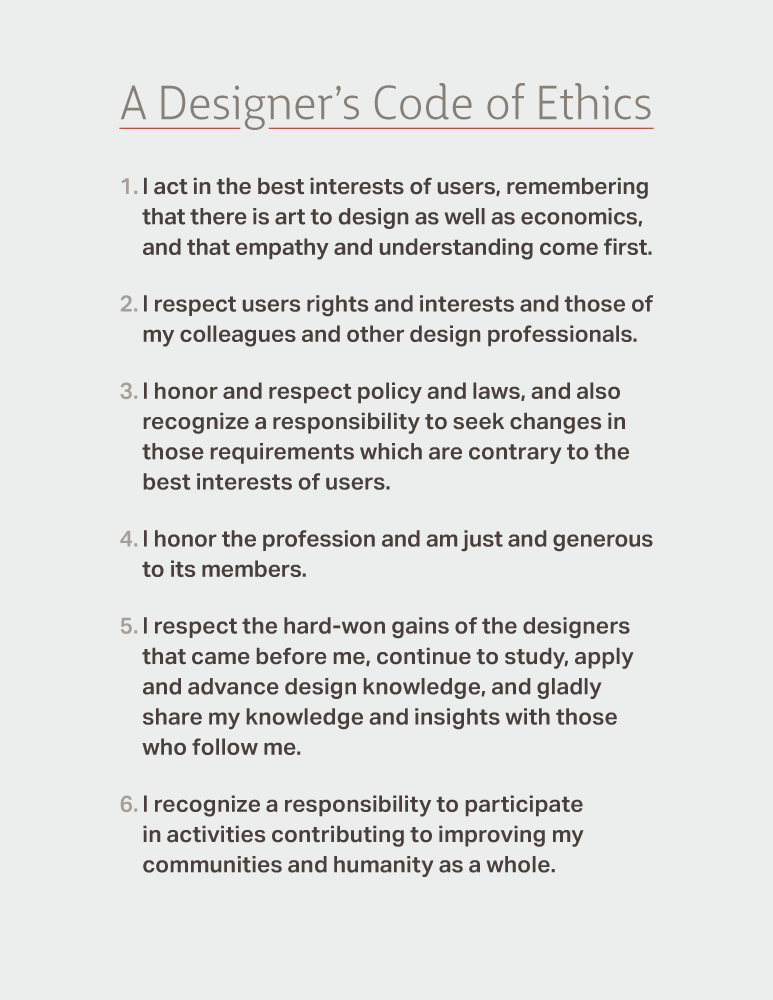
The U.S. Bank Designers' Code of Ethics — co-authored with Rochelle Cherenfant in partnership with the bank's Global Ethics Office. Distributed across the design organization as a working artifact, not a wall poster.
Founding and leading a Design Ethics community of practice inside one of the country's largest enterprise design organizations. I ran the group alongside my formal role — the org sponsored the work, but it was never part of my job description beyond "build community." The group ran for three years (two under my direct leadership), reached about a quarter of the design org directly and all of it indirectly, and produced a Designers' Code of Ethics co-authored with Rochelle Cherenfant in partnership with the bank's Global Ethics Office. When a corporate reorganization shut the group down, participants restarted it independently in 2024 — without being asked.
Problem
U.S. Bank is one of the largest enterprise design organizations in the country and one of the few major financial institutions with a long-standing, publicly recognized commitment to ethics — named one of the World's Most Ethical Companies for 12 consecutive years. The bank maintained an extensive, actively updated Code of Ethics.
None of that had reached the design culture. There was no awareness, no dialogue, no practice specifically of design ethics within the design org. No shared framework for how designers should reason about competing interests, dark patterns, cognitive bias, or the ethics of AI-assisted decisions.
Constraints
A community of practice — which is what I proposed — could build culture and produce artifacts. What it couldn't do was set policy. Sessions had to be closed: discussing ethical concerns about active product work required a protected, off-the-record forum. Adoption depended on the work staying fast and not adding gates. The strategy had to be force-multiplying, not headcount-driven, and the output had to be usable across consumer mobile, business banking, internal tooling, and AI-touched workflows without becoming generic.
What I owned
I identified the structural gap, proposed the community of practice, and founded the group in 2022 while working as AVP, Senior Experience Architect in the Retail Payment Services group (consumer credit cards). The org gave me support and time; the work was not in my JD beyond "build community." I led the group for two years through subsequent title changes (AVP, Senior Experience Strategist; then VP, Development Group Manager in Business Technology Services and Transportation Services), and continued as senior advisor through my departure in November 2024.
I facilitated 75+ meetings — including a series on the constructive use of cognitive bias and rhetorical fallacies — and co-authored the Designers' Code of Ethics with Rochelle Cherenfant, who was both co-author and co-facilitator throughout.
I was independently designated an AI Champion at U.S. Bank — a role I used to bring AI ethicists from elsewhere in the organization to speak directly to the Design Ethics group. At the time, it was the only forum where designers in the bank could hear from internal AI ethics experts.
Key decisions
Build a community of practice, not a governance committee. Naming the constraint up front made the strategy honest. The group could shape culture and produce artifacts; it couldn't set policy. The bet was that practice change in a multi-thousand-person design org would compound even without formal levers.
Closed, weekly, hour-long sessions. The price was visibility. The benefit was real conversation about active product work — including a designer using the group's dark-patterns framework to flag a consumer-facing flow that created pressure toward a financial decision serving the business over the user, and naming it formally in a design review. The group didn't set policy, but it gave designers the tools and language to advocate effectively when it mattered.
Hand-pick founding members across disciplines. I picked the founding cohort from UX, content strategy, accessibility, and UX research — to ensure cross-functional breadth from day one and to seed the heuristic across surfaces.
Work with the Global Ethics Office, not around it. I approached Global Ethics directly to initiate collaboration. They spoke to the group twice and advised the working group on the Code — grounding the work in Mike Monteiro's design-ethics framework and the Hippocratic Oath tradition, and formalizing it in partnership with the bank's own ethics infrastructure.
Build the bridges deliberately. AI Ethics, Behavioral Science, the Community / Heritage Business Resource Groups, and the Grace Hopper sponsorship pipeline were wired in from the first year, so the Design Ethics conversation never sat in isolation.
What changed during the work
The reach surprised us. Within a year the group had reached approximately 25% of designers in the org, with 120 people on the invite list. Members carried the framework into design reviews, into product debates, into conversations with engineering and compliance partners. World Café techniques developed inside the group were adopted by other communities of practice across the bank.
The reorganization that shut the group down in 2024 was the kind of corporate accident that usually kills work like this.
It didn't. Participants restarted the group independently — without being asked, without my direct leadership. I stayed on as senior advisor until I left the bank. A community of practice that survives both its founder's departure and a corporate reorg is evidence of genuine value, not posture.
Outcome
- 75+ sessions facilitated, including a series on the constructive use of cognitive bias and rhetorical fallacies.
- ~25% of the design org reached, 120 on the invite list.
- Designers' Code of Ethics co-authored, grounded in Mike Monteiro's framework and the Hippocratic Oath tradition, in active use across the bank.
- A documented case of a designer using the group's dark-patterns framework to flag and surface a manipulative consumer-facing flow inside formal design review.
- World Café techniques developed in the group adopted by other communities of practice across the bank.
- Group restarted independently in 2024 after a reorg shut it down.
Reflection
A community of practice can build culture and produce artifacts, but it couldn't set policy. In retrospect, earlier and more deliberate efforts to connect the group's work to formal governance processes — design-system standards, product-review criteria, AI-model-evaluation frameworks — would have compounded the impact. The cultural infrastructure was there; the policy bridge was harder to build from within the design community alone, and I would start building toward formal governance levers earlier next time.
The other thing I'd change: capture outcomes more rigorously from the start. The work was real, but the evidence is now harder to reconstruct than it should be. A discipline of writing down what changed in each session — what surfaced in peer reviews because of the heuristic — would have made both the program and the case study stronger.